
There are cities that keep their past underground and others that leave it out in the open, almost without warning. The Roman Theatre of Malaga belongs to the second type: it appears in the heart of the historic centre, at street level, and forces you to readjust the idea you had of the city. In a few steps you pass from the bustle of shops and terraces to a space where the stone, the slope of the land and the semicircular shape of the stands tell a story almost two thousand years old.
This article is designed for you to enjoy it without haste and with context: what you are looking at, why it is there, how to visit it today and how to fit it into your plan for Malaga in a natural way.
1. First impressions: why Malaga's Roman theatre is so surprising
A "street-side" monument in the heart of the historic centre
The first thing that strikes you about the Roman Theatre of Malaga is its location. It is not on the outskirts or in a secluded area: it is part of the most central route, in an area of continuous passage. This proximity makes it very accessible, but also very special: the theatre is not so much "sought" as "found".
That sense of discovery is exciting, especially if you're on a tight schedule. You can arrive, observe it for five minutes and keep walking; or you can stay a while and discover that it is a place with much more reading than it seems.
What you'll see in 5 minutes (and what you'll see better if you stop)
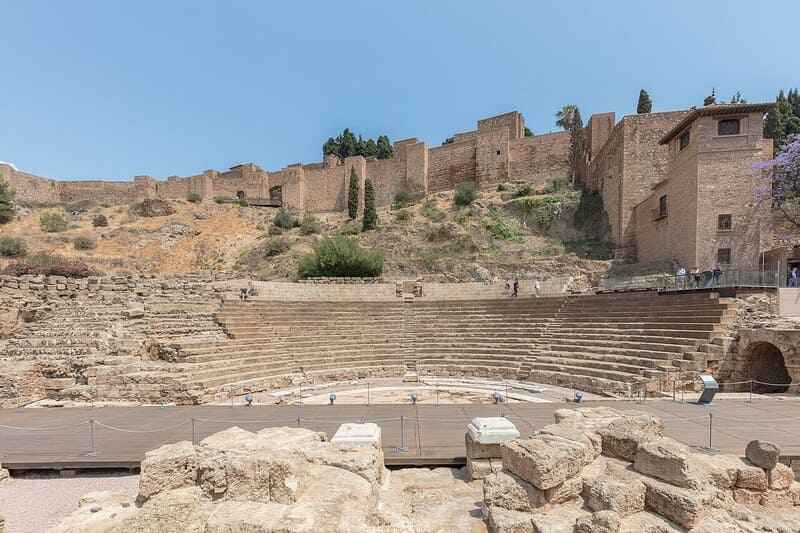
On a quick visit, the most obvious thing is the general shape: the semicircle of the stands and the opening onto the space where the action took place. If you stay a little longer, you begin to notice details: changes in level, remains that show the original layout, and how the theatre blends into the slope of the land.
My recommendation: look first without trying to "understand". Then look again with a clear idea in mind: the theatre was a machine of visibility and sound. Everything - slope, access, form - responded to that.
MÁLAGA Dreams: flat rentals in the centre, next to the Roman Theatre
2. History of the Roman theatre of Malaga in a few stages
Built in the early years of the 1st century AD.
The Roman Theatre of Malaga was built in Roman times, in the early years of the 1st century AD, when the city (ancient Malacca) was part of the Roman Mediterranean world. It was not a minor building: theatres were not only places of entertainment, but also places of public life and urban prestige.
Use, change and neglect over the centuries
Over time, as with many old buildings, the theatre changed function and context. Cities evolve, needs change and spaces are reused. The usual result is that, after losing their original use, these structures are partially hidden, dismantled or integrated into new constructions.
Rediscovery in 1951 and recovery of space
One of the keys to its modern history is that the theatre was discovered in 1951during urban works. That moment marked the beginning of a long process: research, decisions on how to intervene in the environment and, finally, a recovery that made the archaeological site visible.
Heritage protection: declaration as an Asset of Cultural Interest
The theatre is protected as Bien de Interés Cultural (BIC)The Spanish Heritage Protection Act, a figure of heritage protection in Spain that recognises the value of the monument and conditions its conservation and management.
3. What a Roman theatre looks like from the inside: a visual guide so you don't get lost
Understanding the Roman Theatre of Malaga becomes very easy if you look at it as a set of "pieces" with a clear function. You don't need to be an expert: with a couple of concepts, everything fits together.
The cavea: the grandstand and how it adapts to the hillside
The cavea is the grandstand. In Roman theatres, the natural slope is usually used to support part of the structure: the terrain helps, the architecture is complete. In Malaga, this relationship with the hillside is part of the charm: the theatre does not seem "placed", but rather embedded.
Look at the curvature. Imagine the audience filling every stretch. Think of the heat of the day and the shade sought, of the murmurs before the start, of the way the city used to gather here.
The orchestra: the semicircular space in front of the stands
In front of the grandstand is the orchestraThe orchestra, a semicircular space that separates the audience from the main area of action. Although today the word "orchestra" brings us to music, in the Roman theatre the orchestra fulfils a key spatial function: it organises the scene and hierarchises the relationship between performers and spectators.
The scene (scaena) and the place where the show "happened".
The scaena (or stage area) was where the performance took place. In many Roman theatres, this stage front could be monumental and decorated, with doors, columns and architectural elements that reinforced the sense of a theatrical 'world'.
In Malaga, what is preserved and what is interpreted helps you to mentally reconstruct that façade. Even when pieces are missing, the logic of the place is still there: directed gazes, central axis, spaces designed to be seen.
Access and circulation: vomitories, corridors and entrances
Roman theatres were designed to move large crowds without chaos. The vomitories (entrance and exit corridors) and other entrances distribute the public efficiently. Although the term sounds strange today, the idea is simple: get in and out quickly, without blocking the whole.
Notice how these routes connect the outside with the stands. It is architecture at the service of the collective experience.
Findings and artefacts: what has been preserved and what is interpreted today
In an urban site like this, there are two layers of reading: the material (what you see) and the interpretative (what is explained so that you understand what is missing). The ideal is to combine both: look first, and then complete the story with the interpretation of the whole.
MÁLAGA Dreams flat rentals: Roman history on your day trip.
4. The enclave today: how to visit and what experience it offers
Entrance: free visit and what to see from the main points
The visit to the Roman Theatre of Malaga is laid out as an accessible tour, designed to give you a clear view of the whole. Even without a guide, the place is enjoyable: the overall shape of the theatre is very expressive.
A good starting point is to stand to one side and look at the whole semicircle. Then change position and look for the central axis. You will see how the perception changes after a few metres.
Opening hours and closing days
The usual visiting hours are:
-
Tuesday to Saturday: 10:00 a.m. to 6:00 p.m.
-
Sundays and public holidays: 10:00 to 16:00
-
Monday: closed
There are also closures on specific dates in the calendar (such as certain public holidays). If your trip coincides with special days, it is advisable to check before you go so that you don't find the door closed.
Interpretation centre: what is it for and what does it provide before entering?
The complex has a interpretation centre which helps to contextualise what you see: what Roman Malaga was like, how a theatre worked, what was found in the excavations and how the recovery of the space was approached.
If you are interested in understanding, go in first. If you are interested in feeling, see the theatre first and leave the centre for later. Both ways work.
Accessibility and practical recommendations
-
Light and heat: On sunny days, the environment can feel very bright; bring water if you come in summer.
-
Photograph: Being in a central location, there are more crowded times and quieter times; if you want cleaner photos, go early in the morning.
-
Recommended time: You can see it in 10-15 minutes, but if you want to understand it, set aside 30-45.
5. The Roman Theatre of Malaga and the city: its relationship with its surroundings
Why it is where it is: the hill and the cityscape
The theatre is not isolated: its location responds to an ancient urban logic. The hillside allows construction with natural support and, at the same time, places the building in a significant area of the city.
This integration with the terrain can be perceived even today, surrounded by contemporary life. It is part of what makes it photogenic: ancient stone and modern city living side by side.
The connection with the Alcazaba: two epochs in a single glance
One of the great successes of this place is that, very close by, stands the Alcazaba of Malaga. In a few steps you go from Rome to Andalusian and medieval Malaga, and the transition is understood with the body: you go up, you change perspective, you change era.
For international travellers, this contrast is gold: you don't need a lot of scrolling to "see layers of history" in the same scene.
How the morning vs. evening visit changes
In the morning, the visit often feels "sharper": clearer light, less fatigue, more willingness to walk. In the evening, the centre becomes softer, and the theatre can feel more intimate, especially when the heat drops.
If you have a choice, decide according to your style: do you prefer to understand calmly or enjoy with atmosphere?
MÁLAGA Dreams flat rentals and a historical plan in the heart of Málaga
6. What to see near the Roman Theatre in Malaga without making a day of it.
Short walking route through the historic centre
From the Roman Theatre of MalagaThe natural thing to do is to continue walking through the centre. It is an area designed to be done on foot, with easy stops and without logistics.
On a short route you can combine:
-
Roman Theatre + Alcazaba (if you are in the mood for serious history).
-
Stroll through central streets to the Larios Streetideal for keeping your finger on the pulse of the city.
-
A closure near the sea in Pier Oneto exchange stone for breeze.
Nearby viewpoints and walks to complete the experience
If you fancy a panoramic view, Malaga has accessible options in the vicinity of the centre. The fun part is that you can turn the day into a paced tour: ruins → walk → viewpoint → dinner.
Ideas for closing the plan with local flair
No need for an endless list: end the day where there is neighbourhood life in the centre, with terraces, squares and pedestrian streets. Malaga is most enjoyable when you leave room for the spontaneous.
7. Suggested plans to fit in with your trip
If you have only 1 day in Malaga
-
Roman Theatre of Malaga (soft start and very central).
-
Walk through the historic centre.
-
Calle Larios to get a feel for the city of today.
-
Pier One in the late afternoon to lower revs.
If you are interested in historical Malaga (half day)
-
Roman Theatre of Malaga in peace and quiet.
-
Interpretation centre for context.
-
Alcazaba to connect times and heights.
-
Final walk through the centre to close with the living city.
If you are travelling in summer: how to avoid the heat and enjoy it more
-
Visit in the early or late afternoon.
-
Take water with you and avoid the middle of the day if you are doing a lot of walking.
-
Plan indoors (museums, cafés) for the sunniest hours and leave the theatre for when the atmosphere is friendlier.
MÁLAGA Dreams: flat rentals and culture at your fingertips
8. Frequently asked questions about the Roman Theatre of Malaga
What is the Roman Theatre of Malaga?
This is an archaeological site from the Roman period located in the historic centre of Malaga, one of the main Roman remains preserved in the city.
When was the Roman theatre in Malaga built?
It was built in the early years of the 1st century AD.
Where is the Roman Theatre of Malaga located?
It is in the historic centre, in the area around Alcazabilla street, at the foot of the hill where the Alcazaba stands.
Is the entrance to the Roman Theatre in Malaga free of charge?
The visit is offered free of charge as a free visit.
What are the opening hours of the Roman Theatre in Malaga?
The usual opening hours are Tuesday to Saturday from 10:00 to 18:00 and Sundays and public holidays from 10:00 to 16:00, with closures on Mondays and closures on certain dates.
Is there an interpretation centre at the Roman theatre in Malaga?
Yes, the site has an interpretation centre that contextualises the monument before or during the visit.
When was the Roman theatre in Malaga discovered?
It was discovered in 1951 during urban works, and its recovery and enhancement was subsequently promoted.
Don't miss it: related articles
If you feel like exploring Malaga further with more plans that are easy to fit into your trip, here are some other recommended guides:
What to see in Malaga in one dayA practical itinerary for a leisurely stroll through the historic centre, combining walks, culture and stops with atmosphere.
Larios StreetThe essential walk to feel the rhythm of the centre, discover its most elegant side and see why it is always a meeting point.
Central Market of AtarazanasA perfect plan to get to know the local daily life, see fresh produce and take a gastronomic break with the essence of Malaga.
Free museums in Malaga: Easy options to add museums and exhibitions to your route without overspending, ideal if you want to alternate between the beach and the city.
Misericordia Beach in MalagaA wide and comfortable beach to unwind in the city, with a promenade and space for a quiet day.
Plaza de la MercedA square with history and a lot of life, perfect for a stop with terraces and atmosphere in the heart of the city centre.
Constitution SquareThe heart of the historic centre, ideal for finding your way around and linking up with essential streets and places.
Gibralfaro viewpointAn essential panoramic view to see Malaga from above and choose your best moment of the day.
Biznaga of MalagaDiscover the most aromatic tradition of the summer and how to experience it during an evening stroll through the city centre.
Best beaches in MalagaA guide by area and style to choose a beach to suit your plan, from urban to atmospheric coves and sandy beaches.