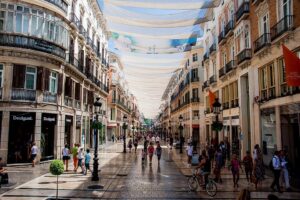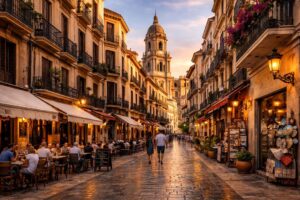

Larios Street, officially Marqués de Larios Streetis one of the most emblematic avenues in Malaga and one of the most elegant urban spaces in Spain. This pedestrian promenade, located in the heart of the historic centre, is today a symbol of the city's urban rebirth, a focal point for commerce, the scene of major events and a place for strolling for both locals and visitors.
Historical background: from cholera outbreak to urban modernisation
The history of Calle Larios is closely linked to the process of urban transformation in 19th century Malaga. After the outbreak of cholera in 1833, the local authorities were forced to modernise Malaga's urban planning and ventilate the old quarter.
In 1880, a limited company was set up, promoted by the influential Larios family, with the aim of opening a large commercial thoroughfare connecting the Plaza de la Constitución with the port. The Larios family contributed 25 % of the investment, and the rest was paid for by the subscription of shares.
Design and construction: symmetry and elegance
The new street was designed by the architect Eduardo Strachan, who was inspired by urban models in Paris and Chicago. The street was designed in a homogeneous classical style, emphasising the symmetry of its façades, uniformity of height (five storeys) and visual harmony. The corners of the buildings were rounded, an innovation that favoured circulation and improved aesthetics.
The works lasted four years, three months and twelve days. Finally, the street was inaugurated on 27 August 1891It was officially named Calle Marqués de Larios, in honour of Manuel Domingo Larios y Larios, the second Marquis of Larios and a key figure in the industrial and economic development of the city.
Transformations in Marqués de Larios Street
During the Second Republic, in 1931, the street was renamed "Calle 14 de abril". However, in 1939, after the Civil War, it recovered its original name. The bronze sculpture dedicated to the Marqués de Larios, the work of the sculptor Mariano Benlliure, was also removed during the Republic and restored years later.
In the year 2002Calle Larios was completely pedestrianised. This decision marked a turning point for the centre of Malaga, which saw its commercial activity revitalised, its tourist attraction and its identity as a lively and modern urban space.
Architecture and urban landscape
The architecture of Calle Larios is one of its most distinctive elements. The neoclassical-inspired façades are arranged in repetitive modules with balconies, elegant cornices and large windows. This aesthetic coherence has earned it comparisons with the great European boulevards and has made the street an ideal setting for parades, concerts and open-air exhibitions.
The statue of the Marqués de Larios is located at the beginning of the street, next to the Plaza de la Marina. It is a bronze sculpture depicting the marquis walking, accompanied by a young worker in an attitude of gratitude. It was inaugurated in 1899 and today it is one of the most popular photographic spots in the centre.
Book your stay at Malaga Dreams and enjoy the city from the centre.
Open-air shopping centre
Calle Larios is the Malaga's commercial artery par excellence. Major national and international brands are present in its shopping areas: fashion, accessories, perfumery, jewellery and catering.
The street is among the most expensive in Spain in terms of commercial rental prices, only surpassed by arteries such as Paseo de Gracia (Barcelona) or Gran Vía (Madrid). This exclusivity has consolidated it as an essential destination for shopping lovers.
Besides the shops, the street is full of life: terraces, cafés and ice-cream parlours invite you to stop and enjoy the urban bustle, especially in spring and summer, when white awnings cover the entire street to mitigate the sun and create an open-air gallery effect.
What to see in Calle Larios
In addition to its history and architecture, Calle Larios is a place full of details and nooks and crannies to discover. Its rectilinear layout allows you to appreciate at a glance the perfect symmetry of its buildings, designed to create a "visual escape effect" towards the Alameda Principal.
One of the most characteristic elements of the street is the summer awningsinstalled every summer to provide protection from the sun and shade. These awnings form a kind of open-air gallery that makes the walk more pleasant and creates a very identifiable urban landscape.
Along the track you will find flagship shopsThe street is lined with historic cafés, traditional ice-cream parlours and terraces where you can feel the daily life of Malaga. The constant traffic of locals and visitors gives the street a dynamic atmosphere, which changes according to the time of day.
At Christmas time, Calle Larios becomes a unique setting thanks to its spectacular Christmas lightingone of the most renowned in Europe. During the Malaga Fair, the street is filled with festive decorations, music, flowers and parades that start from this neuralgic point.
Strolling along Calle Larios is not just crossing an avenue: it is experiencing the urban heart of Malaga, understanding its modern evolution and enjoying one of the most elegant spaces in the south of Spain.
Events and celebrations in Calle Larios
Malaga Fair
During the month of August, Calle Larios becomes the ambassador of Malaga's festive spirit. It is here that the Malaga Fair with the traditional proclamation, an event that kicks off a week of music, dance and popular atmosphere.
The street is decorated with typical Andalusian decorationThe festival is full of lanterns, flowers and elements that evoke the traditional aesthetics of the fair. From early in the morning, the terraces are full of people celebrating the beginning of the festival with Cartojalthe sweet rosé wine that has become a symbol of this time of the year.
Although a large part of the fair takes place at night in the Real de Cortijo de Torres, the daytime atmosphere has Calle Larios and the historic centre as its main meeting point.. Verdiales groups, improvised performances and live music enliven the promenade, creating a festive atmosphere that permeates the entire old town.
The Malaga Fair in Calle Larios offers a more urban and accessible experience than the traditional fair, allowing you to enjoy the local atmosphere in a comfortable and energetic environment.
Christmas lighting
In December, Calle Larios is transformed into one of the most spectacular Christmas scenes in Spain. From 2016the installation of a light and music show has turned this avenue into a major tourist attraction.
Each year, the lighting design changes and is often inspired by artistic or architectural motifs: gothic vaults, starry skies or geometric compositions that wrap the entire street. The lights are synchronised with Christmas music, creating day passes which attract thousands of people throughout the month.
This spectacle has put Malaga on the map as one of Europe's great Christmas destinations, generating enormous media coverage and filling the city with visitors looking to experience it first-hand. The lighting of Calle Larios not only beautifies the historic centre: it has become one of the most recognisable contemporary symbols of the city.
Stay at Malaga Dreams and experience Malaga at a stone's throw from everything.
What to see near Calle Larios
Around Calle Larios is concentrated one of the richest and most dynamic areas of Malaga. Within a few minutes' walk, visitors can discover some of the city's most emblematic places, from historic squares to traditional markets and direct access to the sea. It is an ideal area for further exploration without the need for transport, as everything is integrated into the heart of the historic centre.
Just a few steps away, the Constitution Square appears as a natural extension of Calle Larios. This square has been, since the Middle Ages, the epicentre of Malaga's social and political life. Today it retains its importance as a meeting point, surrounded by stately buildings, classic cafés and terraces where the atmosphere is constant at any time of day. It is the starting point for several historic streets, among them the Company Streetwhich connects with small traditional shops, antique bookshops and the Municipal ArchivesThe building is of interest to those who wish to delve deeper into the city's urban history.
If you take the opposite way, the streets become narrower and lead to the Atarazanas Marketone of the most authentic places in the centre. It preserves the imposing 14th century Nasrid gate that recalls its origin as an atarazana, and inside you will find stalls full of fresh fish, tropical fruits, local olives and small bars where you can savour freshly prepared tapas. It's the perfect place to connect with the daily life of Malaga and enjoy its local gastronomy.
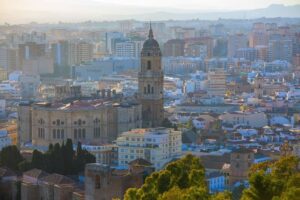
Nearby also stands the Church of the SagrarioThe Cathedral is considered to be one of the finest examples of the late Gothic in Malaga. Its carved stone façade, with a detailed religious iconographic programme, contrasts with the Renaissance architecture of the Cathedral and offers a clear example of the superimposition of styles that characterises the old quarter.
If you continue south, Calle Larios leads directly onto the Plaza de la Marinaone of the great gateways to the sea. From here you can access the Pier One and the Palmeral de las Sorpresastwo modern spaces that have transformed the port into a contemporary promenade full of light, restaurants, shops, landscaped areas and open views of the Mediterranean.
Together, these nearby points form a perfect itinerary to complete the visit: history, architecture, gastronomy and sea in just a few steps. Exploring the surroundings of Calle Larios allows you to understand why this area is the living heart of Malaga and a key point for any tour of the city.
A symbol of Malaga
Calle Larios is not just an urban thoroughfare: it is a symbol of identity for the people of Malaga. It is the place of encounters, of popular celebrations, of social protests and of the most important moments of the city. It is also the starting point to discover the old town, its squares, museums, gastronomy and cultural life.
Its architectural elegance, its history, its commercial dynamism and its prominence in public life have consolidated Calle Larios as one of the most important streets in Andalusia and a must-see for anyone who comes to Malaga.
Tips for visitors
- Best time of the dayat dusk, when the lights come on and the temperature is more pleasant.
- Recommended timesChristmas (for its illumination), August and Spring Fair (vibrant atmosphere and decoration).
- Don't miss outThe sculpture of the Marqués de Larios, the symmetrical façades, the light show in winter and the designer shops.
- TipVisit in comfortable shoes and take the opportunity to explore adjacent streets such as Calle Granada, Calle Nueva and Pasaje de Chinitas.
Book with Málaga Dreams and feel at home in the heart of the city centre.
Calle Larios is the urban soul of Malaga. Born of a health need, converted into a commercial artery and transformed into a symbol of elegance and cultural life, this street reflects the evolution of a city that has known how to preserve its history and project itself into the future.
To walk along Calle Larios is to walk through more than a century of Malaga's history, to admire architecture with character and to experience the present of a vibrant, open, Mediterranean city full of light.
Keep discovering Malaga:
If you want to continue discovering Malaga with plans that fit easily into any route, here are some more ideas:
A complete tour of Malaga in one dayA route designed to make the most of the historic centre without rushing, combining walks, cultural stops and atmospheric spots.
The most authentic market for a gastronomic planPerfect to get to know the local daily life, buy fresh produce and take a break among the flavours of Malaga.
Cultural ideas without overspending: Options to add museums and exhibitions to your trip in a simple way, ideal if you want to alternate between the beach and the city.
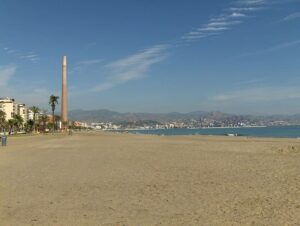
A wide and comfortable beach to disconnectGood plan if you are looking for space, promenade and a sea experience in the city.
A square with history and life at any timeA perfect place to stop, have a drink and feel the real atmosphere of the centre.
The heart of the centre to start any walkThe best reference to orientate yourself and connect with streets, squares and essential places.
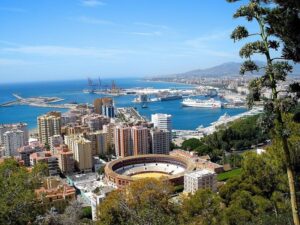
The best panoramic views of the cityA must if you want to see Malaga from above and choose your favourite moment of light.
The most iconic scent of summer nightsDiscover the most sensory tradition of Malaga and how to experience it during a stroll through the centre.
A quick visit to travel to Roman MalagaThe ideal place to understand the historical footprint of the city in the heart of the city, just a stone's throw from other monuments.
Guide to choose your ideal beach according to your planUrban, coves or sandy beaches with atmosphere: a selection to organise several days at sea without complications.