
Walking through the historic centre of Malaga is to enter a Malaga that can be discovered at a strolling pace: streets that invite you to stop, lively squares, façades that change with the light and an atmosphere that mixes the everyday with the monumental. In this guide you will find a clear way to find your way around and choose what to see according to your time, with walking routes and plans that fit in whether you are coming for the first time or if you want to see the city with different eyes.
Why the historic centre of Malaga hooked from the first ride
An old town designed for walking: squares, pedestrian axes and ambience
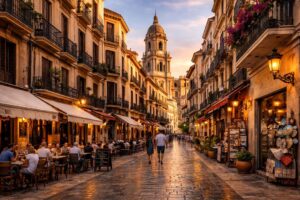
The first thing you notice when you arrive at the historic centre of Malaga is that the promenade rules: everything seems to be set up so that you can move forward without haste, turn a corner and be "treated" to another scene. There is a very comfortable rhythm of short distances, with clearly pedestrianised sections that connect squares where you feel like stopping, looking around and continuing. This combination of lively streets and quiet corners creates a very pleasant sensation: you can link a coffee, a cultural visit, a photo and a break in the shade without having to plan it down to the last millimetre. And the atmosphere adds up: it sounds like conversation, footsteps, terraces and a city that is enjoyed on a human scale, with that touch of energy that makes you think "I'd like to stay a little longer".
What kind of traveller enjoys it most (culture, gastronomy, shopping, museums)
The historic centre of Malaga works especially well for curious travellers who want to "do the city" on foot.
-
If you're thrown by cultureYou will enjoy it because you can combine heritage, historical squares and cultural stops without having to travel far.
-
If you come for gastronomyThe format is perfect: tapas by zones, slow after-dinner conversation and the ease of improvising according to what you feel like at that moment.
-
If you like shoppingThe centre is a great place for a leisurely stroll, to pop in and out of shops and to combine it with a break on a terrace.
-
If museums are your planHere the idea of "one or two must-dos" fits particularly well, and the rest of the day at a light pace, alternating indoors and outdoors so as not to saturate yourself.
The centre of Malaga is attractive because it is easy, comfortable and varied; it allows you to live a lot in a small space, and that turns a normal walk into a complete plan.
Discover the city centre on foot and rest just a stone's throw away: book your flat in Malaga centre
How to find your way around the historic centre of Malaga without missing the best
Usual entry points to start the route (depending on your arrival)
The easiest way to "understand" the historic centre of Malaga is to enter through one of its edges and, from there, walk towards the pedestrian heart.
-
If you arrive by train (María Zambrano): a very practical reference is to approach towards Malaga-Alameda Centre as a starting point on foot. The distance between the station and this area is short (Rome2rio indicates 744 metres between María Zambrano and Centro Alameda), so it allows you to start the route without complication.
-
If you are arriving from the port or are on the coast: it is usually natural to enter through the environment of Plaza de la Marina and link from there to the central axis.
-
If you arrive by car: it should be noted that the centre has areas with controlled/restricted access to trafficThe most convenient way is to leave the car outside the pedestrian area and walk in to avoid detours.
Must-see" areas: squares, key streets and nearby viewpoints
To make sure you don't miss the best, think of the centre as a set of easily recognisable "anchors". Just by memorising 4-6 names, you'll be able to find your way around with confidence:
-
Constitution Square: one of the most useful points to situate yourself and decide where to go next.
-
Marqués de Larios Street: the great pedestrian and commercial axis that serves as your compass; if you find it, everything fits together.
-
Alameda Principal: one of the natural edges of the centre; from here it is easy to walk in and out.
-
Very common connecting streets: Granada Street, New Street y San Agustín Street are frequent references for moving between areas of interest.
-
Plaza del Obispo: a very recognisable corner next to the Cathedral, perfect for "relocating" if you are linking visits.
-
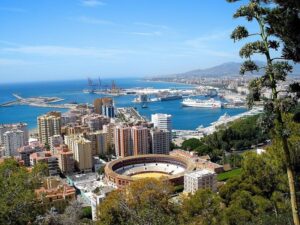
Nearby viewpoints (for extra views): if you feel like elevating the plan, the viewpoints in the surroundings of Gibralfaro (such as the Gibralfaro viewpoint and the La Coracha viewpoint) and the Viewpoint of the Alcazaba are recurrent as reference points for views over the city.
Within walking distance of the essentials: book your stay in our flats in the city centre.
What to see in the historic centre of Malaga: must-see monuments
Roman Theatre and monumental surroundings (visit and best time of the day)
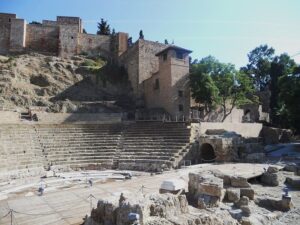
At the foot of the slopes of the Alcazaba, the Roman Theatre of Malaga is one of those visits that is surprising for its location: you find it literally "opening up" in the middle of the city, in Alcazabilla Street. It was built in the 1st century AD and it is the main remaining vestige of Roman Malaga in the historic centre. It was also discovered in 1951 and is declared an Asset of Cultural Interest since 1972This helps to understand its heritage relevance.
On the "best time of the day": as a practical recommendation (not as a fact), it is usually more pleasant to visit early or late afternoon to take a leisurely stroll through the surroundings and link, in a few steps, with the ascent to the Alcazaba. I can't confirm a universal "optimum" time because it depends on the time of year and the number of visitors.
The Alcazaba: the great heritage icon of the historic centre of Malaga
The Alcazaba is, for many, the most recognisable image of the historic centre of Malagaa fortification which during the Islamic period evolved from a defensive enclosure into a palace-fortress and seat of the city government. The visit works very well because it combines the monumental with the sensory: courtyards, walled paths, changes of light and views that appear without the need to "search" for the frame.
An interesting detail to understand the complex is its proximity to the Roman Theatre: official sources explain that the Romans built the theatre on the western slope of the Gibralfaro hill in the 1st century, and that the area was marked by the overlapping of eras that can be seen today on the promenade itself.
Malaga Cathedral: exterior, interior and corners you don't usually see
The Malaga Cathedralpopularly known as "La Manquitaowes much of its nickname to a very specific fact: the south tower was left unfinishedSo the temple was "officially" finished without completing the original plan of two towers. Looking at it from the outside with that idea in mind changes the experience: it is not just a beautiful cathedral, it is a building with a "visible history" in its own silhouette.
To enjoy it without saturating yourself, it usually helps to separate the visit into two layers: first, an exterior walk around its immediate surroundings (squares and streets that frame it); then, the interior, with a more leisurely visit if you are interested in the architecture. I cannot confirm here specific details of internal tours or special access without quoting current official timetable/ticket information.
Calle Larios and the commercial "heart": the most photographed promenade
The Marqués de Larios Street is the axis that orders many walks in the centre: it connects, in a very natural way, the entrance from Alameda Principal towards the more central area. A key fact to understand why walking is so enjoyable is that, after its refurbishment in 2003became pedestrianThis consolidated its role as a major urban promenade.
Beyond shopping, it functions as a "compass street": it allows you to orient yourself, to return to the main axis when you turn off into side streets and, incidentally, to feel the pulse of the centre at any time of the year.
Atarazanas Market (if it fits your route): local experience and flavours
If you want to alternate monuments with a more everyday stop, the Central Market of Atarazanas It fits very well into a walking tour because it adds a different layer: the daily life, the products and the market atmosphere. The current building is the work of the architect Joaquín de Rucoba and stood up between 1876 and 1879its name comes from the former use of the site as a Nasrid atarazanas (shipyards)of which one is preserved monumental marble door integrated into the façade after those works.
The key here is not to "see" quickly, but to go in with a simple idea: look, choose a short stop and keep walking. If your route is very short on time, you can leave it as a flexible plan (only if you are passing through).
Museums and culture in the historic centre of Malaga (choose according to your time)
Picasso Museum Malaga and cultural surroundings
The Picasso Museum Malaga is in the Palacio de Buenavista (Calle San Agustín, 8) and, due to its location, it is a stop that fits in very well with a walking route around the historic centre of MalagaYou are close to the Cathedral, the Alcazaba and the Roman Theatre. The visit tends to work particularly well if you feel like combining art + walkYou can visit the museum at your leisure and, when you leave, you can continue along historic streets without having to "break" the rhythm with long journeys. In the immediate surroundings it is also easy to add small cultural stops (heritage sites, churches, squares and places with history) without turning the plan into a marathon.
Art and painting collections in the heart of the city centre
If your priority is to see painting and art collections without leaving the historic centre, the Museo Carmen Thyssen Málaga (Plaza Carmen Thyssen / C. Compañía, 10) is a very convenient option in terms of location and approach: it allows you to dedicate a block of time to art in a totally central location and continue the day walking through pedestrian streets. To extend the "art in the centre" layer with a more intimate format, the Revello de Toro Museum (Calle Afligidos, 5) usually fits in well as a short visit that doesn't disrupt your route: it's a way of adding culture without "eating up" half a day.
Different options: heritage, customs and traditional Malaga
If you're looking for museums that offer variety (beyond painting), there are two very useful stops in the historic centre of Malaga or one step away:
- Museum of Málaga (Palacio de la Aduana)The building itself and the museums on offer are of great heritage importance, ideal if you want to see a larger cultural block in a single visit.
- Interactive Museum of Music (MIMMA)Calle Beatas, 15: it's a different, more experiential alternative, which breaks away from the "classic museum" scheme and is usually great if you're travelling in a group or want something more dynamic.
And if you fancy a more "interior" Malaga, with an old house atmosphere and decorative arts, the Museum of Glass and Crystal (Plazuela Santísimo Cristo de la Sangre, 2) brings a very different approach to the fabric of the centre.
If you would like to better understand the artistic and historical context of the environment (and not just "see" it), you can complete the visit with a guided tour malaga You won't regret it!
How to combine museums without saturating yourself (1, 2 or 3 stops max.)
The key to enjoying museums in the historic centre of Malaga is to choose a realistic "menu" according to your energy and schedule, and not to try to cover everything:
- Option 1 museum (2-3 hours in total with walk): choose a "main" one (Picasso o Thyssen o Museum of Malaga) and accompany it with a stroll around the nearby monuments. This is the most balanced formula if you also want a terrace, shopping or tapas.
- Option 2 museums (half day): combines one main + one short. For example, a big museum (Picasso/Thyssen/Museo de Málaga) and then a different short visit (Revello de Toro or MIMMA). This way you keep variety without fatigue.
- Option 3 museums (cultural day): only if you really want a day focused on culture. It makes the most sense for all three to be very close The experience becomes a "checklist" and loses its charm. Otherwise, the experience becomes a "checklist" and loses its charm.
Make this route your plan for tomorrow: check dates and prices of our apartments.
Where to eat and what to try: flavours of the historic centre of Malaga
LaTabernilla (Calle Calderería, 7)
If you fancy a tapas tavern in the heart of the city centre, with an extensive menu and non-stop service, LaTabernilla works well to stop without the meal becoming a long plan. For a first time, the best way to go is to order their potato omelette with porra antequerana and Iberian hamadd some sea as the assorted fish fry and, if you want to balance it out, a fresh option such as chopped tomato with avocado, tuna and spring onion.
Kraken Málaga (Plaza de las Flores, 2)
If you are looking for creative tapas in a very central location (Plaza de las Flores), Kraken Malaga is a good choice when you want to try more modern combinations without compromising on the product. To play it safe, its red tuna tartar & avocado from Málaga is a clear first choice; if you fancy something with a different angle, the grilled scallops with spicy gazpacho and the boquerón en vinagre toast & roasted pepper roast fit perfectly into a tapas plan for sharing.
Beluga Malaga (Plaza de las Flores, 3)
When you want one more meal gastronomic and peacefulwith modern cuisine and a more "modern" experience.restaurant", Beluga Malaga is the option on the list that fits best. If it's your first time, an easy way to understand their proposal is to choose the tasting menu (it appears on their menu), or build a meal with representative dishes like the ajoblanco of tender almonds and salted fish and a more "iconic" choice from its line such as bluefin tuna, marrow and caviar.
LOLITA Taberna Andaluza (Calle Granada, 17)
If you fancy a Andalusian tavern with a recognisable and uncomplicated menu, LOLITA is a great place to eat in the centre with classic flavours. For a first time, it works well to start off with a cordovan salmorejo (light and comfortable if you keep walking), follow up with a sea cover as a cod in tempura o cooked white prawnsand top it off with something very much at home, such as the Lolita" omelette with Iberian ham and porra base.
Pez Wanda (Calle Granada, 39)
If you fancy a place with modern tapas and dishes with less traditional twists (international mixes), Wanda Fish is a great fit for a fun meal in the centre. For starters, the Russian salad Wanda is a clear "first time" option; if you want something with a bit more personality, the curried mussels or the Wanda pil-pil prawns (with coriander and lime) The rice dishes (per person, with the minimum indicated on the menu) allow you to turn the plan into a more complete meal.
La Tasquita de en Medio (Calle Calderería, 11)
If your thing is the classic tapas with a lot of variety (pintxos, montaditos, tortillas and raciones) and you want something very central, La Tasquita de en Medio is a very practical option. To order judiciously on the first visit, the white garlic with mojama, grapes and sultanas is a very local choice; if you prefer a strong classic, the antequera truncheon easy to get in; and if you feel like playing with their speciality, their tortillas (with versions such as the "malagueña" with king prawns in pilpil sauce or the "cordobesa" with oxtail) allow you to choose according to your appetite without leaving the tapas format.
Shopping, craftsmanship and details with personality
Streets and shopping areas (fashion, design, souvenirs with taste)
If you want to buy in the historic centre of Malaga without wasting time, stay with three axes very clear:
-
Marqués de Larios StreetThe main shopping promenade in the centre (pedestrianised since 2003), useful for fashion and "passing through" shops while sightseeing (the official municipal reference about Larios and its pedestrianisation is here).
-
New StreetTwo minutes away from Larios, with traditional shops (e.g., Celyanspecialising in fans and complements, in C/ Nueva 29).
-
Surrounding area Cathedral - Calle Císter / San AgustínThe area with craft and pottery shops, literally next to the Cathedral gardens, ideal if you are looking for something "from here" (for example, Alfajarin C/ Císter 1, door 2).
Markets, local produce and small shops to browse in.
Here is one stop that almost everybody likes, because it is tourism + local life in the same place:
-
Central Market of Atarazanas (C/ Atarazanas 10) for shopping and snacks in a market atmosphere. The market itself publishes opening hours MON-SAT 9:00-14:00 (closed on Sunday).
And if you want to take something "ready-made" (no complications) with you:
-
Taste of Spain (nougat and sweets) has shops in the centre at C/ Marqués de Larios 1, C/ Duque de la Victoria 13 y C/ Sta. María 21 (addresses published by the brand itself).
What to take with you that makes sense (with specific names)
No theory and no "generic souvenir"; things that a visitor is usually grateful for:
-
Good, transportable ceramics: a small piece (tile, bowl, plate) of Alfajar (C/ Císter 1, door 2)next to the Cathedral.
-
A real fan (useful and very Andalusian): Celyan (C/ Nueva 29)where the shop itself gives address and contact details.
-
Malaga wine with advice: The Temple of Wine (wine shop in the centre; address published by the shop itself: C/ Sebastián Souvirón, 8). Here the recommendation is not a generic "wine": it is the site where they adjust it to your taste (sweet/semi-sweet/dry) and pack it well.
-
Typical sweet easy to give as a giftnougat/guirlaches in Taste of Spain (shop at Larios 1, for example), very easy to buy "en route" without taking a detour.
Sleeping in the centre changes your trip: see what flats we have available
Frequently Asked Questions about the historic centre of Malaga
What does the historic centre of Malaga include and how long does it take to see it?
The historic centre of Malaga is easy to explore on foot. On an essential route you can see the main sights in 2-3 hours, and in half a day with more cultural stops and time for lunch.
What is the best time to visit the historic centre of Malaga?
For comfortable walking, it usually works best in the early morning or late afternoon. In the middle of the day, alternate walking with museums, markets or indoor stops.
What are the must-see monuments in the historic centre of Malaga?
On a first visit, the most usual thing to do is to prioritise the area around the Roman Theatre, the Alcazaba, Malaga Cathedral and a stroll through the main streets of the old quarter.
Is it possible to walk through the historic centre of Malaga without a guide?
Yes, with a route by zones (monuments, museums and tapas areas) you can organise a circular route and avoid round trips, adjusting it to 2-3 hours or half a day.
Where to eat well in the historic centre of Malaga?
The historic centre of Malaga concentrates options for traditional tapas and modern cuisine. The best thing to do is to choose a specific area and combine 2-3 stops for a leisurely lunch.
What to do in the historic centre of Malaga if it rains?
On rainy days, a plan of museums and indoor stops (market, cafés and cultural spaces) usually works, leaving the outdoor walk for the lulls.