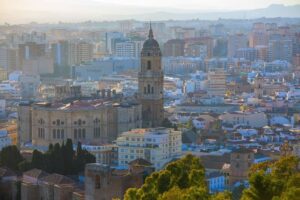

The Plaza de la Merced is one of the most emblematic and oldest public spaces in Malaga. Located in the heart of the historic centre, it has witnessed centuries of urban transformation, political upheaval and moments of cultural splendour. Today, it is a vibrant meeting point for locals and visitors alike, full of history, architectural heritage, Picasso references and everyday life.
Historical origins of the Plaza de la Merced
According to several studies, the origins of the Plaza de la Merced date back to Roman times. It is thought that its current location may coincide with that of an ancient gymnasium or amphitheatre. However, its evolution as a public space came to a turning point after the capture of Malaga by the Catholic Monarchs in 1487. From that moment onwards, the space was consolidated as an open market, then known as the "Plaza del Mercado".
In 1507, a convent of the Mercedarian order was built on the north side of the square, giving it the name it has retained to this day: Plaza de la Merced.
During the following centuries, the square maintained a commercial function and was, for a long time, one of the nerve centres of commerce in the city.
Urban evolution and modern transformations
In the 19th century, the square underwent a significant change with the installation of palm trees, which gave it a new urban and ornamental character. The paving and the reorganisation of pedestrian circulation arrived in 1921, consolidating its structure as we know it today.
One of the most important milestones was the construction of the obelisk in homage to General Torrijos and his comradesThey were shot in 1831 for their defence of liberalism. The monument was erected in 1842 in the centre of the square, over a crypt where their remains rest.
During the 20th century, the square maintained its residential, commercial and cultural use, witnessing historical events and being a regular meeting place.
Your flat rental in MÁLAGA Dreams, a stone's throw from Plaza de la Merced
Picasso and the square: an eternal link
The Plaza de la Merced is also famous for being the birthplace of one of the most influential artists of the 20th century: Pablo Picasso. At number 15 in the square is his birthplace, where he lived until he was ten years old. Today this building houses the Picasso's Birthplace Museumwhich forms part of the Picasso cultural route in Malaga.
A full-length bronze sculpture of Picasso seated on a bench by Francisco López Hernández was unveiled in 2008. The life-size figure has become one of the most photographed elements of the city.
Architectural and memorial elements
The most prominent element is the aforementioned Monument to Torrijosdesigned by Rafael Mitjana in the 19th century. The obelisk stands on a square base and is surrounded by a wrought iron gate. Inside is a funerary crypt where the remains of the general and his companions lie. The marble inscription bears the names of those who were shot and their motto: "I die for the freedom of my country".
As for the façades, the square is delimited by a series of buildings with civil architecture representative of the 18th and 19th centuries. Among them are the following:
- Numbers 9 and 10, from the 17th century, with wide doorways and wrought iron balconies.
- Number 12, which has a unique glass gallery.
- Numbers 15 to 20, known as the Casas de Campos, home to the Picasso Foundation.
The square was one of the first urban spaces in the city to be organised with a regular numbering system, which facilitated the administrative and postal integration of the surrounding area.
Urban life and current use
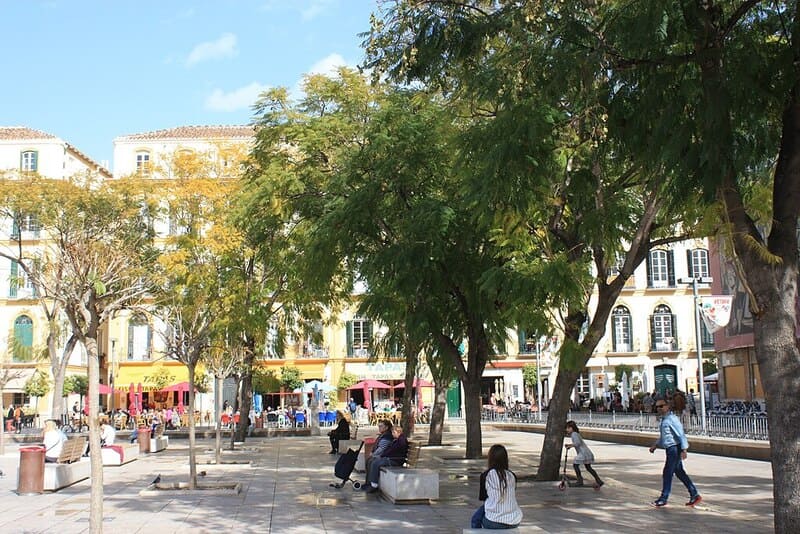
Today, the Plaza de la Merced is one of the liveliest public spaces in Malaga. Completely pedestrianised, it is surrounded by an abundance of ficus and jacaranda trees that provide natural shade all year round. It is common to see residents and tourists relaxing on its benches, sharing a coffee on one of its terraces or taking part in open-air cultural activities.
In recent years, it has also become the site of a monthly craft market called the "La Merced & Co".which is held on the first Sunday of every month. Here, local artisans display handmade products: pottery, clothing, graphic art, jewellery and more. This initiative has reinforced the cultural and community character of the square.
Book at MÁLAGA Dreams: flat rentals and Plaza de la Merced on your route
Cultural and touristic relevance
The Plaza de la Merced not only has historical value, but also fits perfectly into the cultural and tourist routes of Malaga. It is part of the well-known Picassian Routetogether with the Museo Picasso Málaga, the Museo Casa Natal and the Teatro Cervantes.
Its privileged location allows the visitor easy access to other nearby points of interest, such as the Roman Theatrethe Alcazabathe Alcazabilla Streetor the Museum of Malaga.
During local festivities, such as the Malaga Fair, Easter or the Film Festival, the square often hosts special activities, exhibitions and open-air performances.
Monuments and historical sites near the Plaza de la Merced
In addition to its own historical value, Plaza de la Merced is an excellent starting point for visiting some of Malaga's most important monuments, many of which are less than a 5-10 minute walk away.
Picasso's Birthplace
On one side of the square there is the Picasso Foundation - Birthplace Museumlocated in the building where Pablo Picasso was born. The museum houses personal objects, documentation and works related to the artist's childhood and the history of his family.
Monument to Torrijos
In the centre of the square stands the obelisk in homage to General José María Torrijos and his comradeswho were shot in 1831. The monument, in 19th century style, also serves as a mausoleum: the remains of the honoured liberals rest in the crypt.
Sculpture by Picasso
Very close to the obelisk, on one of the benches in the square, you will find the bronze sculpture of Picasso seatedby Francisco López Hernández. It is one of the most photographed spots in Malaga and a symbol of the link between the painter and this urban space.
Cervantes Theatre
A few metres from the square, walking along Gómez Pallete street, you will come to the Cervantes Theatreopened in 1870 and is considered one of the city's main historic theatres. Today it is the venue for numerous cultural events, including the Malaga Film Festival.
Church of Santiago Apostle
Nearby, in Granada Street, you will find the Church of SantiagoOne of the oldest churches in the historic centre. It dates back to the 15th century and combines Mudejar and Baroque elements, forming a regular part of the cultural routes in the old quarter.
Alcazaba, Roman Theatre and Museum of Malaga
Walking down Calle Alcazabilla from the square, in a few minutes you reach three monumental landmarks:
-
The Alcazaba of MalagaThe castle is a palatial fortress dating back to the Islamic period.
-
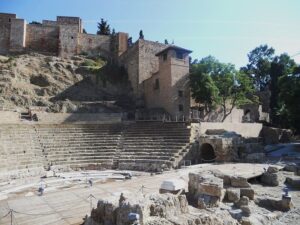
The Roman TheatreThe Alcazaba, at the foot of the Alcazaba, one of the oldest vestiges of the city.
-
The Museum of Malagalocated in the Palacio de la Aduana, which houses the Fine Arts and Archaeology collections of the province.
All this makes Plaza de la Merced a perfect base for exploring the historical and cultural heritage of the centre of Malaga on foot, easily linking you to museums, theatres, churches and archaeological remains within a very short radius.
MÁLAGA Dreams: flat rentals to experience the heart of Málaga
How to get to the Plaza de la Merced
The Plaza de la Merced is in the heart of the historic centre of Malaga, in the district of La Merced, very close to the Alcazaba and the axis formed by Calle Granada and Calle Alcazabilla.
On foot from the historic centre
From Calle Marqués de Larios or Plaza de la Constitución it is a 10-minute walk, following a very pleasant route through the old town (Calle Granada or Calle Alcazabilla). Several urban routes recommend this walk that connects the Alameda, Muelle Uno, La Malagueta, Plaza de la Merced and Plaza de la Constitución in the same pedestrian itinerary.
By public transport
The square is very well connected by city bus. Lines 1, 19, 21, 25 and C2, among others, have stops nearby such as "Plaza de la Merced o "Victoria - Plaza de la Merced".It can also be reached within a few minutes' walk from stops on Paseo del Parque.
If you arrive by Cercanías train (lines C1 or C2) or by metro (L1 and L2), the stations Malaga-Alameda Centre y Guadalmedina are good access points: from there it is a short walk to the Plaza de la Merced through the historic centre.
From María Zambrano station
If you arrive in Malaga by AVE or medium-distance train, from María Zambrano station you can take the city bus line 1 to the square area (stop "Victoria - Plaza de la Merced"), with a journey time of approximately 15-20 minutes and a cost of around €2.
By car and parking
Access by private car is possible, but it is important to remember that the immediate surroundings are pedestrianised. There are underground car parks and private car parks in the vicinity, such as the parking Málaga Grupos - Plaza de la Mercedlocated a few minutes walk from the square.
Tips for visiting the Plaza de la Merced
If you visit Malaga, Plaza de la Merced is a must. Here are some practical tips:
- 📸 Visit Picasso's sculpture and take a photo with him.
- 🏛️ Admission to the Casa Natal Museum (low-cost admission, free on some Sundays).
- ☕ Enjoy a coffee on a terrace under the shade of the trees.
- 🛍️ If you go on the first Sunday of the month, don't miss the craft market.
- 🚶 Stroll along the adjacent streets: Victoria Street, Granada Street or Alcazabilla Street.
- 🌙 In the evening, the square offers a relaxed and safe atmosphere, ideal to start your tapas tour.
The Plaza de la Merced represents the perfect fusion of past and present, art and memory, history and everyday life. From its origins as a medieval market to its transformation into a modern cultural space, the square has evolved without losing its essence. Here ideas were born, monuments were erected and today it continues to bear witness to a city that breathes culture in every corner.
Visiting the Plaza de la Merced is not just sightseeing: it is to immerse yourself in the soul of Malaga.
Book your stay at Malaga Dreams and enjoy the city from the centre.
Recommendations to complete your route
If you feel like adding more plans to your visit, here are some other readings that fit in very well with any tour of Malaga:
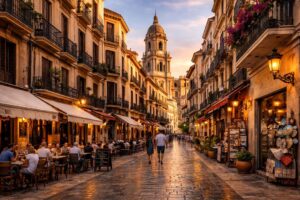
An easy itinerary to see Malaga in one dayA route designed to make the most of the historic centre at your leisure, combining walks, cultural stops and moments to enjoy the atmosphere.
The most famous promenade to experience the centreIdeal to feel the energy of Malaga, to see its most elegant side and to understand why this street sets the pace of the city.
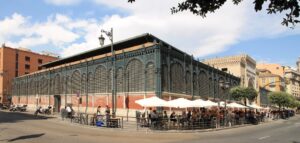
An unmissable stop for food loversPerfect to discover the local produce, to see the daily life of Malaga and to take a break with an authentic flavour.
Admission-free museums and exhibitions: Practical options to add culture to your trip without overspending, ideal for alternating indoor and outdoor plans.
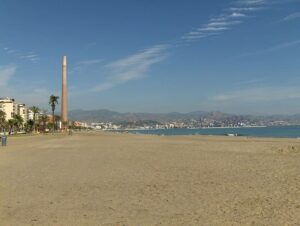
A comfortable beach plan in the cityIf you're looking for space, a promenade and a bathroom without the hassle, this guide will help you organise it.
The most central point to get your bearings and start walking.An ideal reference to connect with the most emblematic streets and move around the old town without getting lost.
A panoramic view to understand Malaga at a glanceA must if you want to see the city from above and choose your best moment of light.
The most aromatic summer tradition in MalagaDiscover what the biznaga is and how to experience it during an evening stroll through the city centre.
A short visit to connect with old MalagaIdeal to understand the Roman footprint in the heart of the city centre and to link with other nearby monuments.
A practical guide to choosing a beach for your styleUrban, coves or sandy beaches with atmosphere: clear options to organise several days at sea without complications.